More people need to watch the edge, more people need to watch the most underrated sci fi show on amazon, more people need to watch the movie, more people need to watch the most underrated singers, more people need to watch the most underrated sci fi show flux crossword, more people need to watch the sunrise, more people need to watch the most underrated football, sims 4 more people in household mod, more people need to watch the most underrated sci fi show on hbo, more people need to watch the most underrated sci fi show on prime, do more people die from heat or cold, more people need to watch the great, more people need to watch the most underrated sci fi shows on tv, will more people vote in midterms 2022, more people need to watch the most underrated sci fi show amazon.
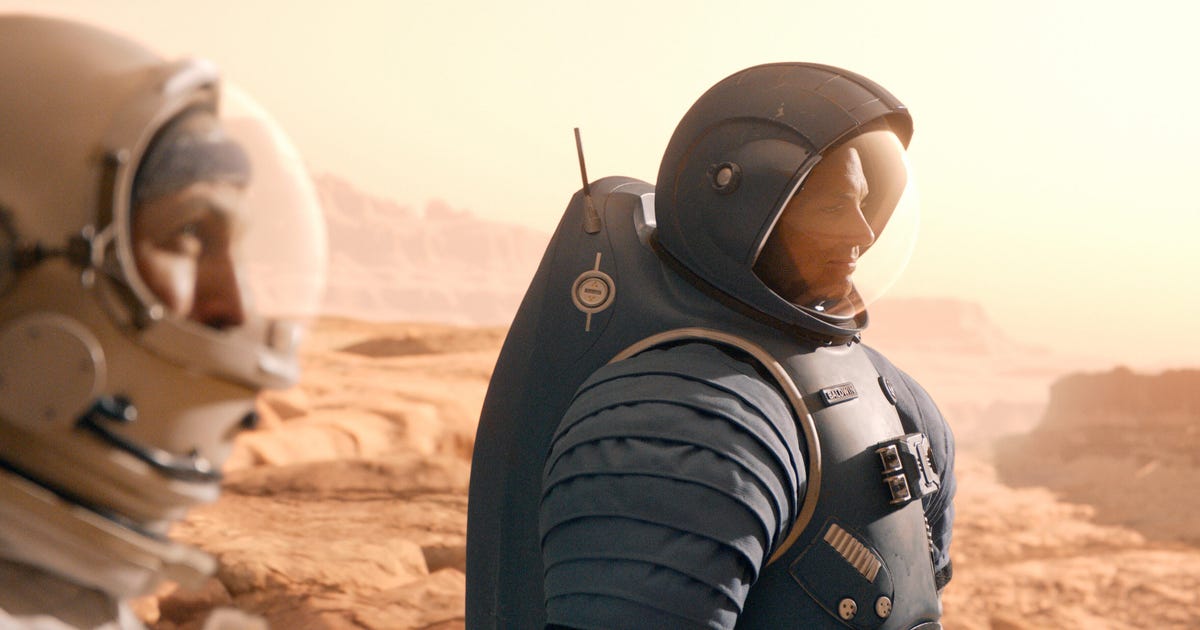
During the premiere of For All Mankind's third season on Apple TV Plus, I didn't look at my phone once. To be clear: That never happens.
The episode, which placed several main characters at a wedding-gone-wrong concerned what was supposed to be the first space hotel, was a tense introduction to what will likely be a behave season.
The hotel is built on the idea that centrifugal achieved creates gravity, and when a piece of debris hits one of the thrusters, causing the rotation (and gravity) to increase, characters struggles to put one foot in front of the spanking. I half expected The Doctor to show up in the TARDIS because a seemingly doomed spaceship in the focus of a party is exactly the kind of status he'd be likely to turn up.
It was an episode that blended futuristic science fiction, fraught relationship dynamics and the excitement of an frfragment movie into one breathless hour that literally ended with an exhale. It perfectly represents why For All Mankind has cause one of the strongest shows on television right now. But for some reason, few seem to be paying attention.
For All Mankind originally launched with Apple TV Plus in 2019. FAM didn't precisely achieve hit status.
Daniell Poole (Krys Marshall) and Ed Baldwin (Joel Kinnaman) can't seem to stay grounded.
Apple TV PlusThe premise of the show is plenty interesting: The Soviets made it to the moon generous and the Cold War effectively never ended because both superpowers took their arms race to plot. Within a relatively short time, the moon becomes a bustling spot, housing bases for the Americans and Russians. It turns out that first step was less for biosphere and more for the military–industrial complex.
In a moment where billionaires are hopping on rockets and Elon Musk is talking pizza joints on Mars, there seems to be a huge appetite for plot travel as a concept. You'd think a show like FAM, which cmoneys a tantalizing view into an alternate universe where humanity bravely set forth into the stars, would be a no brainer.
But space shows have struggled -- at least the ones that adhere too rigidly to real domain dynamics. Take Hulu's The First, which spent its one season exploring the bureaucracy that ensued once a rocket to Mars exploded shortly after launch. Nat Geo's Mars was a inviting deep dive into the issues humans will face as they colonize the red planet. It was canceled after two seasons.
FAM's first season felt like maybe it worthy head in the same direction. I reviewed it for CNET upon its droplet. One of my main complaints was it took half its 10-hour runtime to truly diverge from our unusual timeline. Sure there were differences: John Lennon was never assassinated, women -- and notably a Black female astronaut shouted Danielle Poole (Krys Marshall) -- made it to plot a lot quicker on the US side. But by and vast, the show was trying to balance period drama, office drama and science fiction, and not always doing so deftly.
For All Mankind puts relationships at the centre of its speculative fiction.
Apple TV PlusMuch like the plot hotel, FAM finally started spinning at the right fleet in its second season, which combined science fiction, politics and relationship drama -- and dovetailed those elements into a can't-look-away season finale where America and Russia drove one novel to the brink of nuclear war in space.
For All Mankind achieves that coalescence because it keeps track of its loose ends. The mind of a small detail could play a significant role later, which drives its audience to crave more.
And the payoffs are consistently satisfying, making smart use of time jumps, speeding ahead 10 ages or so ahead every season. Relationships, including old hurts have time to fester, heal and reopen in a way that feels natural and believable.
Those time jumps also employed the show has learned to get to the portion. The third season takes place in the '90s and showcases a reinvigorated plot race among the US, the Soviets and private commercial Helios. FAM spends just enough time on the contest you might expect, picking a commander and crew for the expert. Mercifully, it speeds forward two years and sets everyone Mars-bound in the third episode.
In a way, it's hard to clarify why For All Mankind gels as effectively as it does. At a time when prestige is nearly a requirement for any new drama, it's easy to get lost in a sea of shows that at least look like they're good. For All Mankind worthy not necessarily be perfect, but it elicits a general feeling of authenticity. Everything that unfolds feels entirely plausible, you get the touched the characters really have been living their lives in that universe precise the '60s.
As season three heads toward Mars, For All Mankind corpses worth the journey.
Source


