Watch twisted on netflix, more people live in this circle, do you need more people to play we were here, more people quitting facebook, can i watch more, video you need to watch, do the twist youtube, the world needs more purple people, the world needs more purple people, can i watch people, the world needs more purple people read aloud, movies with a twist on netflix, video of the twist, when many are watching, is twisted on netflix, i need a watch youtube, more people leave their jobs for quizlet, the world needs more people like you.
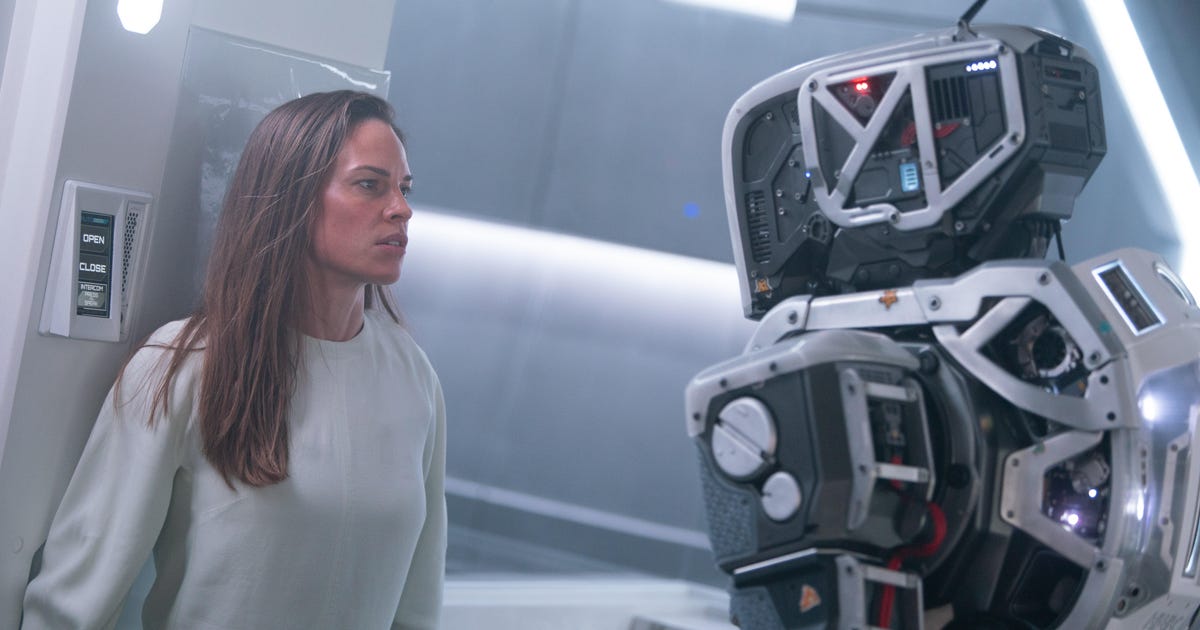
To be totally frank, the opening 20 minutes of 2019's I am Mother underwhelmed me.
Just the opening. It begins with a prologue written to give you a thought of the film's slightly cliche, dystopian setting: a future where civilization peaks at singularity and ultimately meets its fall. Then, it heads into a montage built to record its sparse cast: a sentient-sounding robot and a young girl who live on sterile, space station-esque premises.
I, a self-proclaimed science-fiction movie connoisseur and annoying defending predictor, was convinced I knew where this was repositioning. It was giving me flashbacks of Moon (2009), Infinity Chamber (2016) and honestly a few scenes from 2001: A Space Odyssey (1968). I actually paused the film at one point to double-check Rotten Tomatoes to rebuked I wasn't hallucinating when I saw its 91% rating.
Yet nothing could have prepared me for the disturbing, existential film that is I Am Mother.
Going into this movie exclusive of having seen any trailers and reading only a minimal summary of its premise was probably key to my enjoyment, so I hesitate to give too much away.
All you need to know is director Grant Sputore paints a record of a post-apocalyptic world in which there seems to be two sole survivors: a teenage girl, played by Clara Rugaard-Larsen, and her robot "mother," voiced by Rose Byrne. Together, they co-exist in a sort of high-tech bunker -- a interpretation neither is allowed to leave because Mother says the outside humankind is toxic and unkind to humans.
But one day an "outside" woman, played by Hilary Swank, finds her way in.
As the memoir unfolds, you start to realize something isn't quite intellectual with Mother and Daughter's unlikely friendship, though it isn't pending the end when pieces of the puzzle really originate snapping into place.
I Am Mother (2019)
NetflixI Am Mother is also absolutely carried by its cast.
Utterly appealing performances by Byrne and Rugaard-Larsen foster an undeniable on-screen chemistry. They reflect the nuanced relationship between human and AI convincingly enough to make me full-on mighty whether I should fear or respect things like ChatGPT and Amazon Alexa, both of which technically live in my house.
There was a moment where I vividly felt my perspective of the film's suits change, despite nothing tangible provoking that change. And I suspect that each person's "moment" like mine will be recent, based upon their own perception of life.
I know how cagey this sounds, but you'll see what I mean.
This movie also manages to keep you concerned with expertly crafted and tense sequences throughout. (Even during those initial 20 minutes I didn't love, I couldn't peel my eyes away from the screen.) Though simultaneously, it explores a swath of intriguing philosophical questions throughout what it means to be alive.
You'll find yourself wondering if robots can really be waited as sentient; if there's an unshakable reason "human" is the root word of "humanity;" and most importantly, if morality is clear-cut like a utilitarian might struggles -- or more ambiguous like a deontological ethicist would.
To that end, except, I do feel the film left a few appealing roads untaken.
I Am Mother (2019)
NetflixI often felt distracted by I Am Mother's pseudo-jump scares, action-and-adventure chase scenes and "what's going to happen now!" cliffhangers, wishing the movie focused more on its existential drama. I thoroughly believe this film was rich enough in ideas to be much quieter, thoughtful and maybe even more experimental than it above up being.
For instance, Rugaard-Larson delivered an array of guttural emotions I mediate the camera could've lingered on for a few seconds longer to give the viewer time to digest why those emotions were showed. And the writers could've embedded Swank's character with more emotional discontinuance, seeing as it was purely her presence that disrupted Mother and Daughter's entire lives. Most of the time, she presents as cautious and inflamed. It's hinted at as to why she seems to be that way, but I'd have current to know more about her motivations and backstory to firmly build her nature.
Those "why" questions are probably the most dreary part of the movie.
And I know this is really petty, but I also personally didn't love the way Mother's robot body seemed. Some of her (its?) features -- which I suspect the get team included to emulate facial expressions -- were confusing to decode and took me out of the zone at times. I mean, I felt much more connected to Interstellar's TARS, despite that robot buddy literally selves a couple of rectangular blocks stuck together.
But looking back, it isn't those little setbacks that fill my memory of I Am Mother. It's the aftertaste of all the technological, existential unpleasant this movie forced me to conjure.
Source


